
Verb Logic
Este espacio vive entre lenguas. English and Spanish versions appear below.

When I was a teen my abuelitas told me that I should learn Spanish. This wasn’t just so I could communicate with them. My Abuelita Josefina would say things like, “Mijita, tendrás más oportunidades,” and her mother, my bisabuela Elvira, an astute businesswoman, would add, “Y ganarás más dinero.” I listened politely to them telling me Spanish would give me more opportunities and pay.
But in my head I thought, “Spanish? Who needs Spanish in the workplace?”
At the time, I was a know-it-all teenager and thought my abuelitas were wrong, but still adorable. To humor them, I enrolled in Introductory Spanish my freshman year of high school.
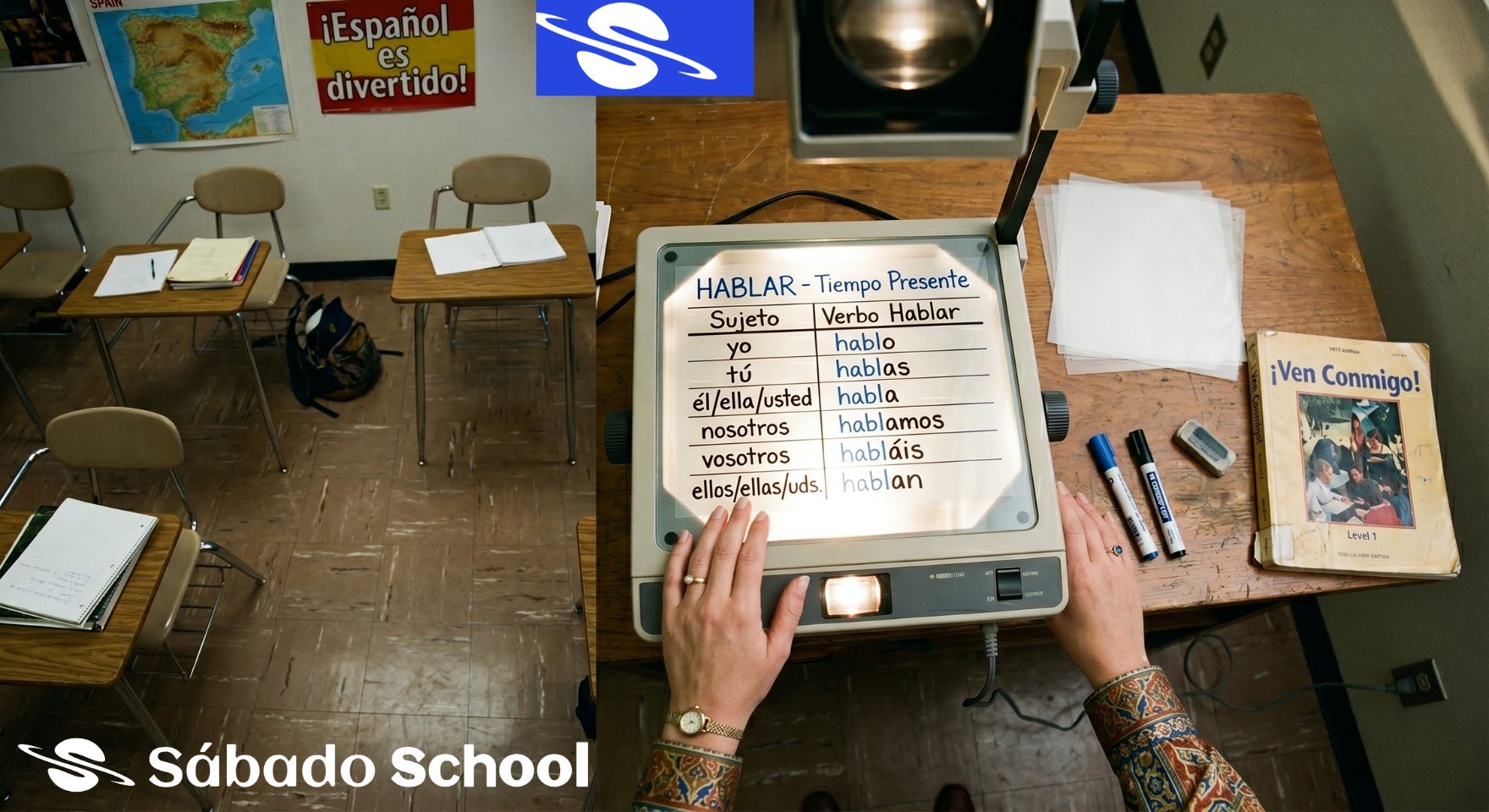
Our teacher Señorita Rodríguez hailed from España. She had great style and accessorized her Spanish with the Castilian th, the one that turns gracias into grathias. Her español to my ears sounded more like ethpañol.
I looked around the room, to see if anyone else knew why she talked like that. Only two of us had ever heard Spanish before, my friend Jason, a Mexican-American, and me, a Salvadoran. To everyone else, ethpañol sounded perfectly normal. No one even raised an eyebrow when she addressed us as vosotros.
Señorita Rodríguez started her classes the same way, each time. She fired up her projector and laid down a transparency sheet she had prepared before class. On it was a predrawn grid with two columns.
Then, she would uncap her marker, and write a verb above the grid, such as hablar (to talk) and indicate the tiempo (tense).
Then she filled in the first column, row by row in her flawless penmanship: yo, tú, él/ella/usted, nosotros, vosotros, ellos/ellas/ustedes.
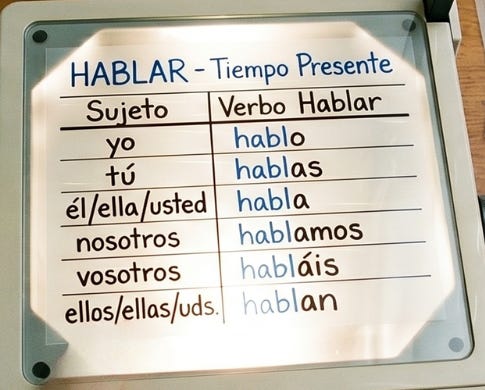
Any other teacher would have filled in the first column and Xeroxed the whole grid—because this column never changed! But not Señorita Rodríguez. She thought that writing this out every day in front of us would help us learn. So we watched her as she wrote the person or people who would be doing that day’s verb.As a heritage speaker, I thought that organizing words this way looked more like math and less like language.
Not to mention, we rarely produced these words in real sentences. They lived in the grid that we would read or listen to her say in ethpañol.
We would see hundreds of these grids throughout the year.
A Verb by Another Ending
Eventually, I had to admit that Señorita Rodríguez’s grids were golden.
But before I tell you why, let’s think about what a verb actually does in a sentence. A verb is where the action is. In English we conjugate or change the verb form to indicate who is doing the action and when it is happening.
Take the word talk. Who is ‘talking’ changes from I talk to he talks. So you change or conjugate the verb depending on the ‘talker.’ When the time period of when someone ‘talks’ changes, such as he talked yesterday, or he is talking right now, or he will talk tomorrow, the verb form changes to indicate whether the action happened in the past, present, or future.
In Spanish, the verb form holds even more weight. A single verb ending can do several jobs that English needs extra words for.
Consider this: a verb can tell you if you should stand up straight and speak formally to someone. If so, you would use the usted form to address your boss, or someone older and wiser. You might say, «Usted habla muy bien» to compliment them.
If you are talking to a sibling or a friend, you would conjugate the verb form as tú. Saying, ¡Hablas mucho! doesn’t need the pronoun to tell someone they are a motormouth and that they are on your level.
One verb ending can tell the room if a single person is gossiping with you, ¿De qué hablas? Change just the ending to -an, and everyone in the room is gossiping with you, ¿De qué hablan?
And a verb in Spanish can even make someone feel included just by adding -mos to the ending. English would require the pronouns us or we to do that. In Spanish you can just put the ending on the verb, and we are gossiping together. ¿De qué hablamos?
Just like English, verbs can take us back to the past, root us in the present, or throw us into the future.
There is even a verb form for things that haven’t happened yet, or that might happen. Things that only exist in a wish, or express a doubt. This is known as the subjunctive, and it is a mood. The subjunctive ending trips me up all the time, so we’ll save that discussion for another sábado.
Because there are so many levels of verb complexity, verb forms are best learned gradually the way you’d climb a ladder: one rung at a time, using a system of logic rather than memorizing long lists.
It took me years to realize that Ms. Rodríguez’s transparency grids are one of the most helpful ways to learn different verb forms—and she knew it.
By using a grid to visually organize the conjugations, you come to see patterns. To really understand the pattern, it’s best for you to produce the grid yourself, rather than trying to memorize 50 conjugation grids.
This is because expressive language—writing out the conjugations—helps you internalize the patterns. This internalization will help you conjugate on the spot when you are actually speaking Spanish.
Which is what my abuelitas encouraged me to do.
METAlinguistic Tactic #20
Build the Grid One Rung at a Time
Instead of trying to memorize a year’s worth of conjugation tables, build one by hand. Then, read it out loud.
Climb the ladder one rung at a time using a system of logic.
Start here, in this order:
One family first: -ar verbs.
Spanish verbs either end in -ar, -er, or -ir.
The -ar form is the biggest group and the friendliest.
Ignore -er and -ir until -ar feels automatic.
Try: llamar (to call), caminar (to walk), pasar (to happen), quedar (to stay) and of course hablar (to talk).One tense first: stay in the present.
Not past, not future, not the subjunctive. Just now.Draw the empty grid yourself.
Six rows: yo, tú, él/ella/usted, nosotros, vosotros,* ellos/ellas/ustedes.
Two columns. Pick a verb — hablar — and fill in the endings (-o, -as, -a, -amos, -áis, -an) by hand. Hablo, hablas, habla, hablamos, habláis, hablan.Write, don’t just read.
Producing the endings yourself (expressive practice) wires the pattern far deeper than rereading a printed table. You’re teaching your hand the shape of the word so your mouth can produce it later.Now swap the verb, keep the grid.
More examples are: trabajar (to work), estudiar (to study), cocinar (to cook). Same six endings(-o, -as, -a, -amos, -áis, -an), every time.
That repetition is the pattern.Add a rung when you master -ar in the present.
Once present-tense -ar is automatic, add -er. Then -ir.
Then one new tense.
Never two new things at once.
The grid I dreaded in the classroom became the grid I trust, especially since I built it myself, one rung at a time.
Turns out my abuelitas were right about the opportunities. Señorita Rodríguez was right about how to earn them, one grid at a time.
*Note: The vosotros row is Spain showing up in Señorita Rodríguez’s Spanish.
If you’re learning Latin American Spanish, you can skip that one for now.
Lógica verbal
Cuando daba clases particulares a adultos, trabajé con una mujer a quien llamaré Rosa. Había llegado a Estados Unidos desde México siendo joven, había criado a sus hijos aquí, y ahora estudiaba para sacar su GED. Su inglés hablado era cálido, rápido y perfectamente funcional. Ella manejaba su trabajo en inglés, y su casa y familia en español. Pero el examen escrito le pedía algo que su oído nunca había tenido que dar, y ahí entraba yo.
Una tarde, trabajando en un pasaje de práctica, se detuvo en una oración que había escrito: “She talk to them.”
Me la leyó en voz alta, segura de que estaba bien. Para su oído, estaba bien. Talk era el verbo. ¿Por qué iba a cambiar?
Yo entendía su lógica perfectamente, porque era la lógica del español. En español, hablar te lo dice todo: hablo, hablas, habla — la terminación hace el trabajo, y una vez que eliges la correcta, ya terminaste.
Rosa tenía toda una vida de verbos que anunciaban exactamente quién hacía la acción. El inglés, calladamente, le había pedido lo contrario, y nadie se lo había advertido.
Así que hice lo que mi propia maestra de español me había hecho a mí una década atrás, aunque no me di cuenta de la simetría hasta después.
Dibujé una cuadrícula.
Escribí to talk arriba y, la llené yo, fila por fila, diciendo cada forma en voz alta:
I talk, you talk… y al llegar a la tercera fila, he, she, it — escribí talks.
Rosa se detuvo. «¿Y por qué esa lleva una -s?»
Ahí estaba. Lo había visto ella sola.
Un verbo que casi no cambia
Antes de contarte por qué esa cuadrícula importa tanto, pensemos en lo que hace un verbo dentro de una oración. El verbo es donde está la acción. Tanto en inglés como en español, cambiamos la forma del verbo para indicar quién hace la acción y cuándo la hace.
La diferencia está en dónde cada idioma guarda esa información.
En español, la guardas en la terminación. Hablo, hablas, habla, hablamos, habláis, hablan—seis personas con seis terminaciones distintas. La terminación carga con todo: te dice quién habla sin que tengas que decir el pronombre. Por eso puedes decir simplemente hablo, y se entiende «yo hablo».
En inglés, casi nada de eso ocurre sobre el verbo.
I talk. You talk. We talk. They talk. He / she / it talks.
Seis personas. Una sola terminación que cambia. La forma es talk en todas partes menos en una: la tercera persona del singular (he, she, it) añade una sencilla -s.
Esto es lo que confundía a Rosa, y con razón. Venía de un idioma donde el verbo cambia cinco veces. El inglés le pedía que lo cambiara una.
La regla que le faltaba cabe en una línea: en el presente, he / she / it lleva una -s al final del verbo.
She talks to them.
¿Adónde se fue la información?
Si el verbo en inglés casi no cambia, surge una pregunta: ¿adónde se fue todo lo que el español guarda en la terminación?
Pues, no desapareció. Se mudó de lugar.
Primero, el quién se mudó al pronombre. En español puedes soltar el pronombre porque la terminación ya dice quién es: hablo basta. En inglés no puedes.
Talk, solo, es una orden, «¡habla!», no «yo hablo». El inglés te obliga a decir I, you, he, she cada vez, porque el verbo ya no lo dice por ti.
Por eso a tantos hispanohablantes se les escapa decir “Is raining” en lugar de “It is raining.” El español les enseñó que el sujeto es opcional. En inglés no lo es.
Segundo, y aquí está el corazón de esta clase, el cuándo se mudó a unas palabritas que se colocan delante del verbo. En inglés las llaman helper verbs, verbos de ayuda (los maestros también les dicen auxiliary verbs, verbos auxiliares).
Donde el español cambia la terminación, el inglés echa mano de un ayudante:
Para el futuro, el español dice hablaré — una palabra, la terminación -ré carga con el tiempo.
El inglés dice I will talk. El verbo no cambia. Llega will, el ayudante, y carga con el futuro por él.
Y para preguntar y para negar, el inglés llama a un ayudante que no tiene equivalente en español: do.
Do you talk?
I do not talk.
Detente en ese último. Tú ya conoces algunos de estos ayudantes sin saberlo, porque el español también los tiene: haber y estar. Cuando dices he hablado, ese he es un verbo de ayuda — igual que el inglés I have talked. Cuando dices estoy hablando, ese estoy hace lo mismo que I am talking. Esos dos cruzan bien de un idioma al otro.
El que no cruza es do.
En español, preguntas cambiando el orden o el tono (¿Hablas inglés?) y niegas con un simple no (No hablo inglés).
El inglés mete un do que no significa nada por sí solo.
Para preguntar: Do you speak English? En español no hace falta ningún ayudante — basta con la entonación y el orden de las palabras: ¿Hablas inglés?
Para enfatizar: Yes, I do. En español el énfasis no viene de un verbo, sino de una palabra como sí o claro: Sí, sí hablo inglés. Claro que hablo inglés.
Fíjate en lo que pasa: en los dos casos, el español dice lo mismo sin ningún ayudante. Por eso do se siente tan vacío — no traduce a nada, porque el español no necesita ponerlo ahí.
No hay nada en el verbo español que te prepare para ese do. Es el único sin equivalente en español y por eso le dedicaremos un sábado más adelante.
La cuadrícula era de oro
Me tomó años entender que las cuadrículas de mi maestra eran una de las mejores formas de aprender los verbos. Con Rosa, la cuadrícula servía igual.
A mí me reveló cuántas terminaciones tenía que aprender en español.
A Rosa le reveló qué pocas tenía que aprender en inglés, y exactamente dónde estaba la única que importaba.
Por eso vale la pena dibujar la cuadrícula tú misma, en lugar de intentar memorizar tablas enteras.
Cuando la escribes con tu propia mano, ves el patrón: cinco casillas iguales y una sola distinta.
La complejidad no está en la terminación.
Está en los ayudantes que vienen delante.
Táctica metalingüística #20
Construye la cuadrícula, un verbo a la vez
En lugar de memorizar tablas de conjugación, dibuja una a mano. Luego, léela en voz alta. Busca patrones, usando un sistema de lógica.
Empieza así, en este orden:
Un tiempo primero: el presente.
Ni pasado, ni futuro, ni preguntas todavía.
Solo el ahora.
Dibuja la cuadrícula tú misma.
Seis filas: I, you, he/she/it, we, you, they.
Elige un verbo: to talk. Luego, llena las formas a mano.
Vas a escribir talk casi siempre. La única que cambia es he/she/it, que lleva -s:
I talk. He talks.
La única regla del presente: la -s de la tercera persona.
He talks. She runs. It works.
Esa -s es casi toda la conjugación del presente en inglés.
Es la regla que le faltaba a Rosa.
Escribe, no solo leas.
Producir las formas con tu propia mano (práctica expresiva) graba el patrón mucho más hondo que releer una tabla impresa.
Le estás enseñando a tu mano la forma de la palabra para que tu boca la produzca después.
Cambia el verbo, conserva la cuadrícula.
Prueba con to work, to live, to want.
El mismo patrón cada vez: igual en todas las filas menos en he/she/it.
I work. She works.
Esa repetición es el patrón.
Cuando la -s salga sola, te toca conocer a los verbos de ayuda: esos ayudantes que se colocan delante del verbo para marcar el tiempo.
Apréndelos uno por uno: will para el futuro (I will talk), y am/is/are …-ing para la acción en curso (I am talking).
El pasado es la excepción amistosa: no necesita ayudante, solo una terminación:
-ed. I, you, he/she/it, we, you, they talked.
Deja para el final los irregulares — sobre todo to be (am/is/are), el más rebelde.
Y también ese ayudante do que no tiene gemelo en español.
A Rosa, esa cuadrícula casi vacía le pareció un error. Era demasiado simple para ser cierta.
Resultó ser la herramienta que la acercó a su GED, porque la construyó con su propia mano.
Un peldaño a la vez.