
The Brain Between Languages
Este espacio vive entre lenguas. English and Spanish versions appear below.

The City That Lives in Two Tongues
The first time I traveled to Barcelona, I had prepared myself to navigate the city in Spanish. I studied verb tables and common phrases, my preparation offered up like a small devotion. And then I stepped off the plane.
The first sign I read wasn’t in Spanish. It was in Catalan. Sortida. Exit.
In the cafés, I heard conversations slide between languages mid-sentence. A grandmother ordering un tallat in Catalan, then giving directions to tourists in Spanish. The bus driver greeting one passenger with bon dia and responding to another with buenos días, calibrating language in real time. Most people in Catalonia move between two languages with the confident gait of someone walking down a familiar hallway in the dark. Undeniably, though, some prefer Catalan. They lean into it. They protect it. The language carries something Spanish does not, at least not for them: a sense of place, a sense of self.
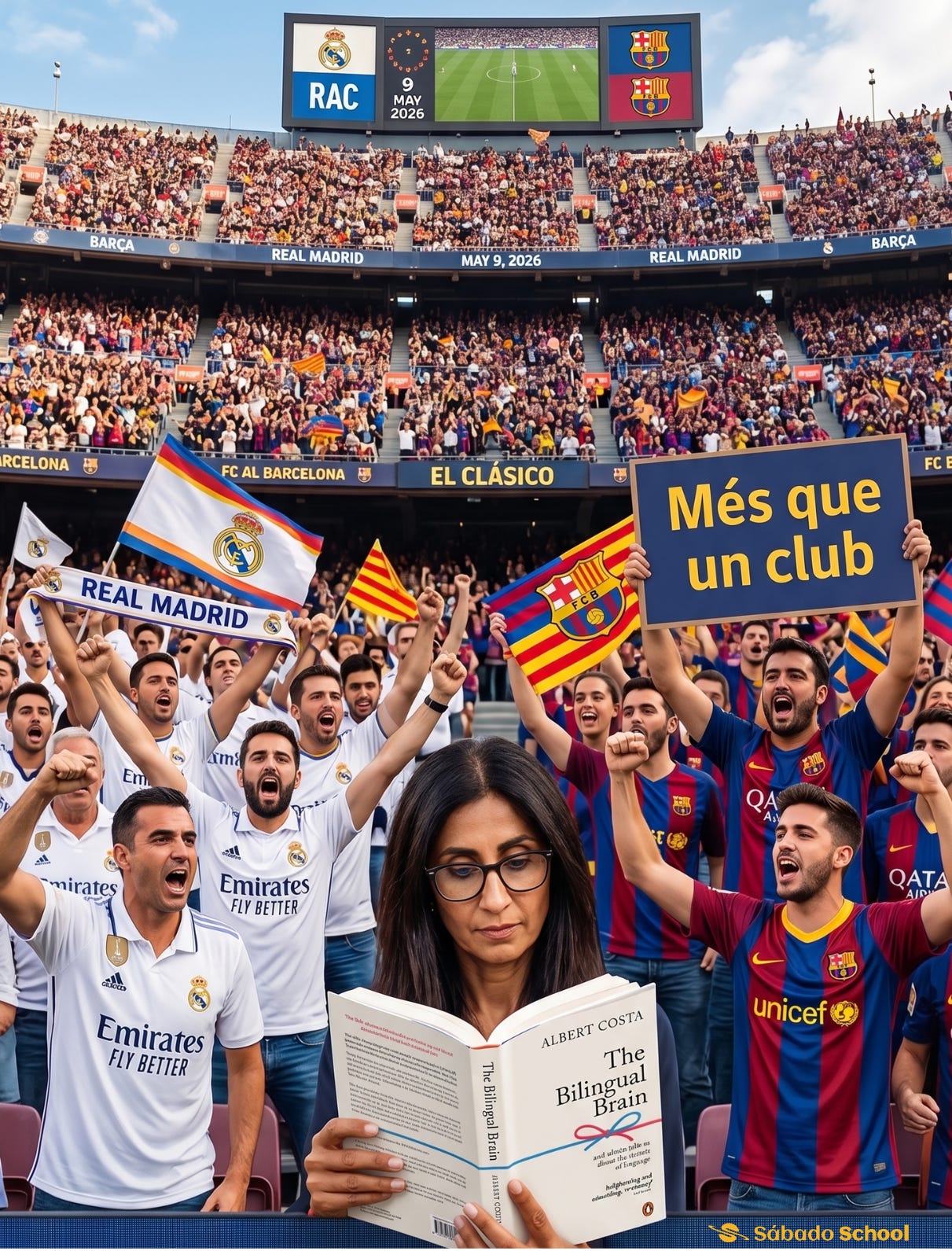
You feel this everywhere in the city, but nowhere more viscerally than at a Clásico. When Real Madrid plays FC Barcelona, the rivalry is not just sporting. It is linguistic, political, and ancestral.
Més que un club — “more than a club” — is the Barça motto, and it is written, of course, in Catalan. The chant roaring in the stadium is not simply about football. It is about which words you choose to feel proud in.
I left Barcelona with a burning question that had been smoldering for years: what is actually happening in the mind of a person who lives this fluidly between two languages?
As a Spanish-English bilingual, I had grown up knowing that the language I used at family gatherings was not the same instrument I used at school. That something in me shifted when I switched, that certain words could only be said in certain rooms with certain people. Long before I could explain it, I was living it.
Then came my travels to Oaxaca, where bilingualism wasn’t a matter of two languages but which of the many. Mexico recognizes sixty-eight indigenous languages; Oaxaca is home to more than a dozen including: Zapotec, Mixtec, Mazatec, Chinantec, Triqui, Mixe, Chatino. Each language carries cosmologies that Spanish translations can not render in full.
In Oaxaca, I met students of all ages who had arrived at school speaking a language their teacher did not, who learned Spanish as a second tongue, and later, English as a third. Their “multilingual brains” were holding entire worldviews in trust for the next generation.
Later, working in U.S. public schools, I encountered the luminous, yet often invisible multilingualism of a country that officially insists it is monolingual. In a single urban district, students may collectively speak more than a hundred languages. Children seek out their same-language peers and build small linguistic islands together. Their teachers — well-meaning and often under-resourced — do their best to help them acquire English. Over time, the students build their cognitive architecture: a bilingual brain doing extracurricular work no one is grading.
By the time I arrived in Barcelona, my question was fully aflame. Here, I could observe adults in public, performing bilingual cognition with everyday grace.
Not long after, I picked up the book, The Bilingual Brain, written by Catalan psycholinguist, the late Albert Costa, and discovered that he had spent his career asking, with extraordinary rigor, the same question my life and travels had lit up in me.
When I ask what is happening inside the bilingual brain, I am asking on behalf of a Catalan grandmother speaking to her grandson, a Ñuu Savi (Mixtec) girl learning Spanish in school, a Mam-speaking student in an Oakland classroom. The research extends to me-search, contemplating the younger version of myself simultaneously saludando a la familia, while learning to read in English.
For years, I had read that bilinguals are essentially translating, running a quiet little subtitle track behind their thoughts.
But it turns out that’s not what’s happening at all.
The Myth of the Internal Translator
Fluent bilinguals do not translate. They select.
When a Catalan speaker reaches for the word enyorança — Catalan for that ache of longing for something or someone absent — they are not first thinking nostalgia and then converting. They are pulling directly from a conceptual space, and the language that fits the feeling shows up first. The Spanish language is also active in the background, ready, but suppressed.
This is the part most people miss. Bilingualism is not “one language plus another.” It is a permanent state of managed coexistence. Both languages are awake at all times. The brain is always choosing which one gets to speak.
To understand what that choosing actually builds, and what it costs, I had to read the works of two researchers who, between them, mapped for me the deep architecture of this skill.
The Recycled Brain
The French cognitive neuroscientist Stanislas Dehaene proposed an idea that rewired how we understand human learning. He called it neuronal recycling.
The puzzle he was trying to solve rings philosophical. He looked at the process of reading, a cultural invention only a few thousand years old. That is far too recent for evolution to have built a dedicated brain region for it. And yet, in literate humans across every script, reading reliably activates the same small patch of cortex, the visual word form area.
How can a cultural invention have a fixed biological address?
Dehaene’s answer: the brain doesn’t develop new real estate for new skills. It repurposes old circuits. The region that helps us recognize letters was originally tuned for recognizing objects, faces, edges in the visual world. Literacy moved in and renovated. The older functions aren’t erased; they shape and constrain what the new function can become.
This is a profound idea, because it tells us something about what the brain is. It is not a blank slate, and it is not a fixed instrument either. It is an old building under continuous, intelligent renovation.
Bilingualism, seen through this lens, is one of the most ambitious renovations the human brain ever undertakes. A second language doesn’t get its own clean wing of our cerebrum. Instead, our second language threads itself through the existing language network: sharing circuits, competing for them, reshaping them. The bilingual brain is not two brains side by side. It is one brain that has learned to host two systems, living in the same room, knowing, at every moment, which room to turn the lights on for.
Which is exactly the problem Albert Costa spent his career studying.
Your Brain is Conducting Traffic
Costa’s central insight was this: when you speak one language, the other one does not politely turn off. It is active. It is competing. Every time a bilingual opens their mouth, their brain has just finished suppressing an alternative.
He demonstrated this with elegant experiments. When bilinguals are asked to name pictures rapidly, switching between languages on cue, they pay what’s called a switch cost: a tiny, measurable lag.
And here is the strange and telling detail: the switch cost is asymmetric.
Picture this. You're speaking English all day, and then your maestra de español calls. You switch into Spanish to greet her — and that switch, into your weaker language, is the costly one. English has to be forcefully held back at a cost so Spanish can rise. When you hang up and turn back to your English-speaking colleague, the switch is almost free; English just snaps back into place.
This isn’t because the weaker language is harder to produce in that moment, but because the dominant language has to be forcefully suppressed first, like holding a door shut while a quieter voice tries to speak.
That inhibition work your brain is doing, you don’t even feel. But it is there.
This work has a name: executive control. It is the same family of mental functions that lets you focus on a conversation in a noisy restaurant, resist a distraction, or hold two competing rules in mind at once.
Costa argued that bilinguals exercise this system constantly, in the most ordinary acts of speech, across a lifetime. And this exercise leaves neurological traces.
We know Bilingualism is a superpower: bilingual infants as young as four months can detect a language switch by watching silent mouths. Bilingual children show subtle advantages in perspective-taking and reduced egocentric bias. There is evidence, though still debated, that lifelong bilingualism delays the onset of dementia symptoms by several years.
And true to the enterprise of science, comes something I love about Costa: his objective research. He resisted the seductive headline of “bilinguals are smarter.” He showed, just as honestly, that bilinguals have more tip-of-the-tongue moments, and sometimes carry a smaller vocabulary in each individual language. That’s a real tradeoff, but one I am willing to take.
Costa’s legacy leaves us with an important metaphor. The bilingual brain is conducting traffic all day long. Two streams of language, one set of intersections, preventing collisions. With training, the traffic conductor gets better at conducting.
What the Science Misses
Here is where the lab data ends and lived experience begins.
Bilinguals know things about themselves that no fMRI has yet measured. We know that languages are not interchangeable containers for the same thoughts; they are differently shaped vessels, and some feelings fit better into one of them. We know that emotional words — te quiero, I’m sorry — do not weigh the same in every language we speak, and that the language of childhood often holds a gravity difficult to match.
Costa’s own research bears this out: the emotional charge of a word is reliably greater in the dominant or first-learned language. We feel more in our mother tongue. We reason more coolly in our second.
This is why bilinguals code-switch. Not because they are confused, but because they are reaching for precision, that exact word, in the exact register, with the exact emotional temperature, in the language that is hosting it.
For those holding language against the pressure of inhibition, this is not an academic point. It is survival. It is how a grandmother keeps a homeland alive in a language that has emigrated. It is how a child of immigrants negotiates two identities in the same sentence. It is how Catalans, generation after generation, have used their language for self-determination and cultural preservation.
This is what the Real Madrid–Barça rivalry is carrying, beneath the football.
A language is never just a language.
It is who you are, spoken aloud.
Metalinguistic Tactic #18
The Switch Notice
Notice your switches. Without judgment. Without trying to change anything. Simply observe.
Which language do you count in when you’re tired or doing math in your head?
Which language do you dream in?
Which language do you comfort someone in?
Which language do you solve problems in?
What you will find, almost certainly, is that your languages have specialized. They have divided the labor of your inner life between them. One might handle the spreadsheets, while another handles the lullabies.
This is not a sign of fragmentation. It is a sign of integration. Your brain has built a custom routing system. A system for what to send through which channel, when to switch, and when to hold one language back so another one can speak.
That is the cognitive flex of bilingualism.
I think back, now, to that first afternoon in Barcelona. I was watching a city of people whose brains had become skilled at conducting two languages at once.
The bilingual brain is not split. It is not divided loyalties or half-fluencies or a translator running in the background. It is a brain that has been trained, by life, to live with two systems and choose between them with grace.
If you grew up between languages, if you live between them now, if you are raising a child who will—the way you hold them together is the quiet masterpiece of your mind.
Vivir entre lenguas
La ciudad que vive en dos lenguas
La primera vez que viajé a Barcelona, me había preparado para moverme por la ciudad en español. Estudié tablas de verbos y frases comunes; mi preparación ofrecida como una pequeña devoción. Y entonces bajé del avión.
El primer letrero que leí no estaba en español. Estaba en catalán. Sortida. Salida.
En los cafés, oía conversaciones que se deslizaban entre lenguas a media frase. Una abuela pidiendo un tallat en catalán, y luego dándole indicaciones a unos turistas en español. El conductor del autobús saludando a una pasajera con bon dia y respondiéndole a otra con buenos días, calibrando en tiempo real. La mayoría de la gente en Cataluña se mueve entre las dos lenguas con el paso seguro de quien camina por un pasillo conocido en la oscuridad. Y innegablemente, algunos prefieren el catalán. Se inclinan hacia él. Lo protegen. La lengua carga con algo que el español no lleva, al menos no para ellos: un sentido de lugar, un sentido de sí mismos.
Esto se siente en toda la ciudad, pero en ningún lugar de manera más visceral que en un Clásico. Cuando el Real Madrid juega contra el FC Barcelona, la rivalidad no es solo deportiva. Es lingüística, política, ancestral.
Més que un club —”más que un club”— es el lema del Barça, y está escrito, por supuesto, en catalán. El cántico en el estadio no trata simplemente del fútbol. Trata de las palabras que uno elige para sentirse orgulloso.
Salí de Barcelona con una pregunta encendida que llevaba años ardiendo a fuego lento: ¿qué está pasando, en realidad, dentro de la mente de una persona que vive con tanta fluidez entre dos idiomas?
Como bilingüe en español e inglés, había crecido sabiendo que la lengua que usaba en las reuniones familiares no era el mismo instrumento que usaba en la escuela. Que algo en mí cambiaba cuando cambiaba de idioma; que ciertas palabras solo podían decirse en ciertos cuartos, con ciertas personas. Mucho antes de poder explicarlo, ya lo estaba viviendo.
Después vinieron mis viajes a Oaxaca, donde el bilingüismo no era cuestión de dos lenguas, sino de cuál entre muchas. México reconoce sesenta y ocho lenguas indígenas; Oaxaca por sí sola alberga más de una docena que incluye: zapoteco, mixteco, mazateco, chinanteco, triqui, mixe, chatino. Cada idioma tiene sus propias cosmologías que el español no logra expresar plenamente.
Allí conocí a estudiantes de todas las edades que habían llegado a la escuela hablando una lengua que su maestro no entendía, que aprendieron español como segunda lengua y, más tarde, inglés como tercera. Sus «cerebros multilingües» custodiaban cosmovisiones completas para la próxima generación.
Más adelante, trabajando en escuelas públicas de Estados Unidos, me encontré con el multilingüismo luminoso, y a menudo invisible, de un país que oficialmente insiste en ser monolingüe. En un solo distrito urbano, los estudiantes pueden hablar, entre todos, más de cien lenguas. Los niños buscan a compañeros que hablen su mismo idioma y juntos crean pequeñas «islas lingüísticas». Sus profesores —bienintencionados y a menudo con pocos recursos— hacen todo lo posible por ayudarles a aprender inglés. Con el tiempo, los alumnos construyen su arquitectura cognitiva: un cerebro bilingüe que realiza un trabajo extraescolar que nadie califica.
Para cuando llegué a Barcelona, mi pregunta ardía en plena llama. Allí pude observarla desde afuera: adultos en público ejecutando la cognición bilingüe con tal gracia cotidiana.
Poco después tomé el libro The Bilingual Brain, escrito por el psicolingüista catalán Albert Costa —ya fallecido—, y descubrí que él había dedicado su carrera a hacer, con un rigor extraordinario, la misma pregunta que mi vida y mis viajes habían encendido en mí.
Cuando pregunto qué está pasando dentro del cerebro bilingüe, lo pregunto en nombre de una abuela catalana y su nieto, de una niña ñuu savi (mixteca) aprendiendo español, de un estudiante mam en un salón de clases en Oakland. La investigación se extiende a la introspección, en la que contemplo a mi yo más joven saludando a la familia al mismo tiempo que aprende a leer en inglés.
Durante años leí que las personas bilingües, en el fondo, traducen — que llevan un pequeño subtítulo corriendo en silencio detrás de sus pensamientos.
Resulta que no es eso lo que ocurre.
El mito del traductor interno
Las personas bilingües con fluidez no traducen. Eligen.
Cuando un hablante de catalán alcanza la palabra enyorança —ese dolor por la ausencia de algo o de alguien—, no piensa primero en añoranza y luego la convierte. Tira directamente desde un espacio conceptual, y el idioma que mejor calza con el sentimiento aparece primero. El otro idioma también está activo en el fondo, listo, pero suprimido.
Aquí está lo que la mayoría pasa por alto. El bilingüismo no es «una lengua más otra». Es un estado permanente de coexistencia administrada. Las dos lenguas están despiertas todo el tiempo. El cerebro siempre está eligiendo cuál habla.
Para entender qué construye y qué cuesta esa elección, tuve que leer los trabajos de dos investigadores que, entre los dos, me ayudaron a comprender la estructura profunda de esta habilidad.
El cerebro reciclado
El neurocientífico cognitivo francés Stanislas Dehaene propuso una idea que reorganizó nuestra comprensión del aprendizaje humano. La llamó reciclaje neuronal.
El enigma que intentaba resolver suena casi filosófico. La lectura es una invención cultural de apenas unos miles de años. Demasiado reciente para que la evolución haya construido una región cerebral dedicada a ella. Y, sin embargo, en personas alfabetizadas de todas las escrituras del mundo, la lectura activa de manera fiable la misma pequeña zona de la corteza: el área visual de la forma de las palabras.
¿Cómo puede una invención cultural tener una dirección biológica fija?
La respuesta de Dehaene: el cerebro no construye espacio nuevo para habilidades nuevas. Reutiliza circuitos viejos. La región que nos ayuda a reconocer letras estaba originalmente afinada para reconocer objetos, rostros, bordes en el mundo visual. La lectura llegó y la renovó. La función original no se borra; le da forma al nuevo uso y lo limita.
Es una idea profunda, porque nos dice algo sobre lo que el cerebro es. No es una hoja en blanco, ni un instrumento fijo. Es un edificio antiguo bajo una renovación continua e inteligente.
El bilingüismo, visto desde aquí, es una de las renovaciones más ambiciosas que el cerebro humano emprende. Una segunda lengua no recibe su propia ala limpia del cerebro. Se entreteje con la red lingüística existente: comparte circuitos, compite por ellos, los reconfigura. El cerebro bilingüe no son dos cerebros lado a lado. Es un solo cerebro que ha aprendido a alojar dos sistemas en las mismas habitaciones, y a saber, en cada momento, en cuál encender la luz.
Que es, exactamente, el problema al que Albert Costa dedicó su carrera.
Tu cerebro está dirigiendo el tráfico
La intuición central de Costa fue esta: cuando hablas una lengua, la otra no se apaga cortésmente. Está activa. Está compitiendo. Cada vez que un bilingüe abre la boca, su cerebro acaba de terminar de suprimir una alternativa.
Lo demostró mediante elegantes experimentos. Cuando se pide a personas bilingües que nombren imágenes rápidamente, cambiando de idioma a una señal, pagan lo que se denomina un «coste de cambio»: un pequeño retraso medible.
Y aquí está el detalle extraño y revelador: el coste de cambio es asimétrico.
Imagina esto. Llevas el día entero hablando español, y de pronto te llama tu hijo, criado en Estados Unidos, para contarte algo en inglés. Cambias al inglés para responderle —y ese cambio, hacia tu lengua más débil, es el costoso. El español tiene que ser contenido a la fuerza para que el inglés pueda salir. Cuando cuelgas y vuelves a la conversación en español con tu hermana, el cambio es casi gratuito; el español regresa solo a su lugar.
No porque la lengua más débil sea más difícil de producir en ese momento, sino porque la lengua dominante tiene que ser suprimida con fuerza primero, como sostener una puerta cerrada mientras una voz más callada intenta hablar.
El cerebro está haciendo un trabajo de inhibición que tú nunca sientes.
Ese trabajo tiene un nombre: control ejecutivo. Es la misma familia de funciones mentales que te permite seguir una conversación en un restaurante ruidoso, resistir una distracción o sostener dos reglas que compiten en la mente al mismo tiempo.
Costa argumentó que las personas bilingües ejercitan este sistema de manera constante, en los actos más ordinarios del habla, y que a lo largo de una vida ese ejercicio deja huellas.
Sabemos que el bilingüismo es un superpoder: bebés bilingües de apenas cuatro meses ya pueden detectar un cambio de lengua mirando bocas en silencio. Niños bilingües muestran ventajas sutiles en la toma de perspectiva y un menor sesgo egocéntrico. Hay evidencia, todavía debatida, de que el bilingüismo a lo largo de la vida retrasa la aparición de los síntomas de la demencia varios años.
Y, fiel al espíritu de la ciencia, hay algo que me encanta de Costa: su investigación objetiva. Resistió el titular seductor de “los bilingües son más inteligentes”. Mostró, con la misma franqueza, que las personas bilingües tienen más momentos de “lo tengo en la punta de la lengua” y a veces cargan con un vocabulario menor en cada lengua individual. Es una verdadera decisión de compromiso, pero estoy dispuesto a aceptarla.
Nos deja con una metáfora importante. El cerebro bilingüe está dirigiendo el tráfico todo el día. Dos corrientes de lenguaje, un conjunto de cruces, evitando colisiones. Con la práctica, el regulador de tráfico mejora en su labor.
Lo que la ciencia no alcanza a ver
Aquí termina el dato de laboratorio y empieza la experiencia vivida.
Las personas bilingües sabemos cosas sobre nosotras mismas que ninguna resonancia magnética ha medido todavía. Sabemos que las lenguas no son recipientes intercambiables para los mismos pensamientos: son vasijas de formas distintas, y algunos sentimientos solo caben en una de ellas. Sabemos que ciertas palabras emocionales —te quiero, perdóname— no pesan igual en cada lengua que hablamos, y que la lengua de la infancia suele tener una gravedad que las otras no alcanzan.
La propia investigación de Costa lo confirma: la carga emocional de una palabra es de manera fiable mayor en la lengua dominante, o en la primera aprendida. Sentimos más en la lengua materna. Razonamos con más frialdad en la segunda.
Por eso las personas bilingües hacen code-switching. No porque estén confundidas, sino porque buscan precisión: esa palabra exacta, en el registro exacto, con la temperatura emocional exacta, en la lengua que la esté alojando.
Para quienes defienden su lengua frente a la presión de la represión, esto no es una cuestión académica. Es una cuestión de supervivencia. Es la forma en que una abuela mantiene viva su tierra natal a través de una lengua que ha emigrado. Es la forma en que un hijo de inmigrantes concilia dos identidades en una misma frase. Es la forma en que los catalanes, generación tras generación, han utilizado su lengua para la autodeterminación y la preservación cultural.
Esto es lo que la rivalidad Real Madrid–Barça lleva debajo del fútbol. Una lengua nunca es solo una lengua.
Es una afirmación sobre quién eres, en voz alta.
Táctica metalingüística #18
El aviso del cambio
Nota tus cambios. Sin juicio. Sin tratar de cambiar nada. Simplemente observa.
¿En qué lengua cuentas cuando estás cansado o haces matemáticas en la cabeza?
¿En qué lengua sueñas?
¿En qué lengua consuelas a alguien?
¿En qué lengua resuelves problemas?
Lo que vas a encontrar, casi con certeza, es que tus lenguas se han especializado. Han dividido el trabajo de tu vida interior entre ellas. Una lleva las hojas de cálculo. Otra lleva las canciones de cuna.
Esto no es un signo de fragmentación. Es un signo de integración. Tu cerebro ha creado un sistema de enrutamiento personalizado. Un sistema que determina qué enviar por cada canal, cuándo cambiar y cuándo dejar de lado un idioma para que pueda expresarse el otro.
Esa es la flexibilidad cognitiva del bilingüismo.
Ahora recuerdo aquella primera tarde en Barcelona. Observaba una ciudad llena de personas cuyos cerebros se habían vuelto expertos en manejar dos idiomas a la vez.
El cerebro bilingüe no está dividido. No se trata de lealtades divididas, ni de una fluidez a medias, ni de un traductor funcionando en segundo plano. Es un cerebro que ha sido entrenado, por la vida, para convivir con dos sistemas y elegir entre ellos con elegancia.
Si creciste entre dos idiomas, si vives entre ellos ahora, si estás criando a un niño que lo hará... la forma en que los mantienes unidos es la silenciosa obra maestra de tu mente.